Years ago, I visited a Weight Watchers meeting to learn more about the program and blogged about it here. An anti-diet proponent, I tried my best to be unbiased, and I walked away from the meeting thinking that as far as diets go, WW wasn't the worst-of-the-worst and that the meeting offered some cognitive behavioral tips and social support.
But still, it's a diet.
And diets can be incredibly damaging, even when they refresh their marketing campaigns and "allow" you things like unlimited fruit and especially when they start bequeathing you extra food allowances earned via exercise.
Recently, I met a woman I'll call Jessie. When Jessie told me that she was on Weight Watchers, my response was a simple, "Why?" To be honest, part of this was because Jessie was someone whom I'd describe as "normal" weight. I asked her from where on her body she planned to lose the weight. "I've already lost 13 pounds," she said, "And I still have a little to go." Okay. Well, the reality is, I would question anyone who told me she was on Weight Watchers, regardless of her size, because I think the diet mentality can create a disordered relationship with food, which ironically for her purpose, can lead to weight-gain over time.
Jessie and I ate brunch at a friend's home. Said friend served a beautiful spread - we each had some frittata, fruit, and a slice of banana bread. Now, here's where it gets interesting. Jessie ate what my friend served her, and then after the fact, told me that she was now going to have to make this a "cheat" day.
"What do you mean?" I asked. "That was a healthy breakfast!" I campaigned.
"I know," she said. "But I don't know how many points it was. And if I can't calculate the points, then I might as well just eat whatever I want the rest of the day and make it my cheat day."
Now, Jessie didn't mean that she planned on eating intuitively the rest of the day. She meant that she was going to overeat -and here's the kicker - not because she had overeaten already (which some people do out of black-and-white thinking) - but because she couldn't calculate the points and had therefore landed herself in Weight Watchers' no-man's land.
For some reason, I tried to protest. "How many points could it have been? I was satisfied but not even full."
"It's the banana bread," she replied. "The banana bread at Starbucks is almost my full-day's point allowance. If I have that, I can't eat much the rest of the day."
That criminal, homemade, small slice of banana bread. . . I was getting nowhere.
Weight Watchers, and other diets, set people up to alternate between periods of restriction and overeating. The rigidity, the rules, and the monumental distance from intuitive eating are all disordered in my mind. That a plan could say "Fine, you had your banana bread, now starve yourself until tomorrow" and call itself a flexible plan and, in any way, designed to promote health, is miles beyond my comprehension.
Want a true Weight Watchers disaster story? Read here how one woman dropped the program and regained a healthy relationship with food.
Now, that's a good plan.
Wednesday, May 21, 2014


Wednesday, May 14, 2014
Parenting Healthy Kids
Actress Drew Barrymore was quoted in February's New York magazine: "I wasn't a rebellious kid. Actually, I rebelled with junk food, because my mother was so psychotically healthy that I was like, I'm going to hide Doritos under my bed."
Barrymore's experience isn't unique. A recent article in the New York Times discussed how restricting children's access to foods can backfire, making these forbidden food even more desirable to kids.
And yet, that's what parents continue to do.
In an online parenting community I frequent, one mother expressed concern about her young daughter's eating and burgeoning weight. She noted this daughter ate more than her siblings and was in the 95th percentile for weight.
One responder, who identified as a parent educator, recommended the whole family go on a diet, either Paelo or GAPS, both of which restrict grains/carbs. She noted that her son went from "chunky" to lean on the diet she chose. Other parents applauded this mom's approach.
And of course, I had something to say in response:
Parents' attempts to restrict food can backfire and lead to overeating (same happens when we self-restrict as adults). It's important, as parents, that we focus on health, not weight. Choose foods that are nutritious and get kids moving (not exercising) in a joyful way. Labeling foods as "good" or "bad" can also backfire, as the "bad" foods become more coveted and sought out. Here's a good summary of some positive parenting/eating principles.
Bodies are naturally diverse, as are our biologies. The attitudes we have about weight in our culture are incredibly damaging and can be transmitted to our kids even without our awareness. True, we don't want our kids bullied for their weight, but it's important that we're building them up at home. If they are eating beyond fullness or they're sedentary, that's important to address. Are they using food to cope or soothe? But if they're eating intuitively and are active, then at some point, we need to accept that bodies come in different shapes and sizes.Stay tuned for an article version of this post, which will be published soon on a health and wellness site.
Monday, May 12, 2014
Healthline's Best Eating Disorder Blogs of the Year
Check out our new award from Healthline! Thanks to my readers for making this the blog it is.
The other blog awardees are not to be missed - check them out here.
 |
Tuesday, May 06, 2014
Celebrating International No Diet Day with a Comment on Tabloid Weight Loss
At the supermarket recently, my eye caught this display:

Yes, that's right - four weight loss cover stories, all in a single glance.
We are bombarded on a daily (read: momentary) basis by content like this.
Sometimes, the weight-loss plans these magazines tout as effective aren't even responsible for said weight loss. In a feature in January's US magazine, actress Melissa Joan Hart is interviewed about her post-baby 35-pound weight loss. Hart reports turning to Nutrisystem in order to shed the weight and discusses benefits of the plan.
But, here's the funny part. The article states: "She shed the first 30 pounds before starting the program." So, yes, this Nutrisystem success story and company spokesperson dropped (best-case scenario) only five pounds on the plan. Oops.
These magazines sell content like this because we're buying it. Weight-loss plans and programs are only lucrative because we believe these stories.
We need to get smarter. We need to look at these magazine covers as no different than those featuring stars adopting alien babies. And we need to demand better content, because wouldn't it be a treat to be checking out at the grocery store and see a cover story that celebrates women or actually makes us think?
Yes, that's right - four weight loss cover stories, all in a single glance.
We are bombarded on a daily (read: momentary) basis by content like this.
Sometimes, the weight-loss plans these magazines tout as effective aren't even responsible for said weight loss. In a feature in January's US magazine, actress Melissa Joan Hart is interviewed about her post-baby 35-pound weight loss. Hart reports turning to Nutrisystem in order to shed the weight and discusses benefits of the plan.
But, here's the funny part. The article states: "She shed the first 30 pounds before starting the program." So, yes, this Nutrisystem success story and company spokesperson dropped (best-case scenario) only five pounds on the plan. Oops.
These magazines sell content like this because we're buying it. Weight-loss plans and programs are only lucrative because we believe these stories.
We need to get smarter. We need to look at these magazine covers as no different than those featuring stars adopting alien babies. And we need to demand better content, because wouldn't it be a treat to be checking out at the grocery store and see a cover story that celebrates women or actually makes us think?
Wednesday, April 30, 2014
A Little Less Mindfulness?
There's a movement in the field toward mindful eating, focusing on our meals and attuning to hunger and satiety, pace of eating, etc. As a mindful eater, you might tune into the texture and flavor combinations of certain foods. You might revel in the color palette on the plate before you, or the warmth of a reduction as it first hits your palate. Perhaps you'll focus on the people and process that culminated in the fare in front of you. A move toward mindfulness can promote intuitive eating and reduce inattentive (or dissociative) overeating in those who identify this as a concern, and a likely majority of eaters could benefit from a more mindful approach.
But I think there's a limit to all this mindfulness.
I've heard some people report that they have trouble going out to eat because it interferes with their conscious eating. And sometimes, we're so focused on the need to eat mindfully, that we counter-intuitively forego eating when we're hungry because we're in the middle of something else.
One of Geneen Roth's eating guidelines, for instance, suggest you "Eat without distractions. Distractions include radio, television, newspapers, books, intense or anxiety-producing conversations or music."
While I like Roth's guidelines in general, I think it's possible to cultivate a healthy relationship with food, even if you eat with music or television in the background, or (gasp!) with a book, magazine, newspaper, or your smartphone in front of you. When I used to lead meal process groups at an eating disorder treatment center, we often had music on to accompany our meals. And, with increasing frequency, I eat at my desk with my computer as a backdrop to my meal. Sometimes, I even eat in my car.
There, I said it.
But, this doesn't mean I'm 100% checked out. Conscious eating starts when you decide what to eat and when you plate your food. It means checking in to hunger signals before you begin to eat. And it means checking in with your body for fullness and satiety at times throughout the eating experience. It doesn't mean sitting down at your computer with a Costco-sized meal, checking out, and letting the chips fall where they may.
Where I differ from many of the mindful eating folks is that I think it can be healthy and flexible to tune out, too, as long as you check back in. Granted, this won't necessarily work for someone early in process of recovery from binge- or emotional eating, but I see it as a goal for most. Perhaps some meals we'll eat mindfully, and some we'll go back and forth.
Having to eat always with no distractions seems overly rigid to me, the kind of rule that gets people into trouble with food in the first place. To me, fluidity in conscious eating seems more on the mark. It's a commitment to responsibility and pleasure. It allows you to converse with others, to watch your favorite program, or listen to some background music, while enjoying the food in front of you. It allows you to eat at movie theaters, ball games, and on the road. It allows mealtime to be a pleasurable, engaging process that is adaptable and flexible, ultimately aspirational, in my mind, for every disordered eater.
But I think there's a limit to all this mindfulness.
I've heard some people report that they have trouble going out to eat because it interferes with their conscious eating. And sometimes, we're so focused on the need to eat mindfully, that we counter-intuitively forego eating when we're hungry because we're in the middle of something else.
One of Geneen Roth's eating guidelines, for instance, suggest you "Eat without distractions. Distractions include radio, television, newspapers, books, intense or anxiety-producing conversations or music."
While I like Roth's guidelines in general, I think it's possible to cultivate a healthy relationship with food, even if you eat with music or television in the background, or (gasp!) with a book, magazine, newspaper, or your smartphone in front of you. When I used to lead meal process groups at an eating disorder treatment center, we often had music on to accompany our meals. And, with increasing frequency, I eat at my desk with my computer as a backdrop to my meal. Sometimes, I even eat in my car.
There, I said it.
But, this doesn't mean I'm 100% checked out. Conscious eating starts when you decide what to eat and when you plate your food. It means checking in to hunger signals before you begin to eat. And it means checking in with your body for fullness and satiety at times throughout the eating experience. It doesn't mean sitting down at your computer with a Costco-sized meal, checking out, and letting the chips fall where they may.
Where I differ from many of the mindful eating folks is that I think it can be healthy and flexible to tune out, too, as long as you check back in. Granted, this won't necessarily work for someone early in process of recovery from binge- or emotional eating, but I see it as a goal for most. Perhaps some meals we'll eat mindfully, and some we'll go back and forth.
Having to eat always with no distractions seems overly rigid to me, the kind of rule that gets people into trouble with food in the first place. To me, fluidity in conscious eating seems more on the mark. It's a commitment to responsibility and pleasure. It allows you to converse with others, to watch your favorite program, or listen to some background music, while enjoying the food in front of you. It allows you to eat at movie theaters, ball games, and on the road. It allows mealtime to be a pleasurable, engaging process that is adaptable and flexible, ultimately aspirational, in my mind, for every disordered eater.
Wednesday, April 23, 2014
We're Up on Amazon!

Thursday, April 17, 2014
Countdown to June 1st!
"What happens then?" you ask. . . .
The unofficial start to summer?
Bikini season? (ahem)
The anniversary of when Anne Boleyn was crowned Queen of England?
Nah.
It's the publication of my book!

Stay tuned for more information and thanks, as always, for your unrelenting support.
The unofficial start to summer?
Bikini season? (ahem)
The anniversary of when Anne Boleyn was crowned Queen of England?
Nah.
It's the publication of my book!
Thursday, April 10, 2014
Exercise in Peace
Coming to the end of a challenging spin class, our instructor walked us through the readouts on the gym's new bike consoles.
"Now look down at the most important number on your console: the calories."
I disagree.
As a fitness professional, I think the most important number on the bike console is the watts, how much power generated during the workout, followed second by miles, how much (albeit fake) distance traversed. Calories? Eh.
The calories listed on any workout machine are grossly inaccurate. The instructor completely missed the boat on this one, stating that the caloric reading was accurate, independent of height and weight and other individual variables. Not so. Calories burned during a workout are a reflection of the energy used by the heart and muscles, and each person uses a different amount of energy to complete a workout. If you're less fit, you'll burn more calories at the same level of work than your marathoner friend. Your heart rate can typically predict caloric output, but unless you're wearing a heart rate monitor, this measure on cardio machines is inaccurate, too.
The instructor then went through a crowd-rousing competition. "Who burned more than 400 calories? 500? 600? 700?" Participants cheered out in celebration of their (inaccurate) caloric burn.
As a psychologist, I think there is no number tied to a successful workout. My biggest gripe with this ending to a positive and inspiring class is that, even if the readout were 100% accurate, it doesn't matter how many calories you burned. Spinning classes, like any workout, are about increasing fitness, strength, endurance, and power. It's a time to challenge yourself and clear your head. It's a celebration of being healthy and alive.
When you start measuring calories, you miss the point. For some, this turns into a compulsive relationship with exercise, where movement becomes penance for intake. Workouts become painful, instead of challenging, punishing instead of inspiring. For the class participants who struggle with an eating disorder or body image concerns (and yes, they are taking these classes), comments about calories can be difficult to hear and can even trigger disordered behavior.
Join me in challenging the fitness industry's focus on exercise as compensation for meals. Choose a goal for your workouts that is independent of calories burned (think goals related to speed, distance, experiencing feel-good chemicals, just getting out the door). Explain to your trainers and group fitness instructors why a focus on calories is tangential at best and harmful for many.
Exercise in peace.
"Now look down at the most important number on your console: the calories."
I disagree.
As a fitness professional, I think the most important number on the bike console is the watts, how much power generated during the workout, followed second by miles, how much (albeit fake) distance traversed. Calories? Eh.
The calories listed on any workout machine are grossly inaccurate. The instructor completely missed the boat on this one, stating that the caloric reading was accurate, independent of height and weight and other individual variables. Not so. Calories burned during a workout are a reflection of the energy used by the heart and muscles, and each person uses a different amount of energy to complete a workout. If you're less fit, you'll burn more calories at the same level of work than your marathoner friend. Your heart rate can typically predict caloric output, but unless you're wearing a heart rate monitor, this measure on cardio machines is inaccurate, too.
The instructor then went through a crowd-rousing competition. "Who burned more than 400 calories? 500? 600? 700?" Participants cheered out in celebration of their (inaccurate) caloric burn.
As a psychologist, I think there is no number tied to a successful workout. My biggest gripe with this ending to a positive and inspiring class is that, even if the readout were 100% accurate, it doesn't matter how many calories you burned. Spinning classes, like any workout, are about increasing fitness, strength, endurance, and power. It's a time to challenge yourself and clear your head. It's a celebration of being healthy and alive.
When you start measuring calories, you miss the point. For some, this turns into a compulsive relationship with exercise, where movement becomes penance for intake. Workouts become painful, instead of challenging, punishing instead of inspiring. For the class participants who struggle with an eating disorder or body image concerns (and yes, they are taking these classes), comments about calories can be difficult to hear and can even trigger disordered behavior.
Join me in challenging the fitness industry's focus on exercise as compensation for meals. Choose a goal for your workouts that is independent of calories burned (think goals related to speed, distance, experiencing feel-good chemicals, just getting out the door). Explain to your trainers and group fitness instructors why a focus on calories is tangential at best and harmful for many.
Exercise in peace.
Monday, March 31, 2014
#ICED2014 Recap (Media Highlights)
The keynote speaker was Frank Bruni, current Op-Ed columnist and past restaurant critic for the New York Times. Bruni, a heavy child, spoke about his history with dieting, weight stigma, and ultimately, an eating disorder, as he began purging as a way to compensate for eating off-diet foods. Here are a few things Bruni found useful in his recovery:
1) Recognizing that he's not built to be a skinny man and accepting that he has a larger appetite than others
2) Becoming obsessed with food quality rather than quantity - thus his parlay into food criticism
3) Refusing to cast eating behavior as a measure of willpower or character
4) Getting bothered by how much time he was spending on food obsession and how ultimately boring an endeavor this was
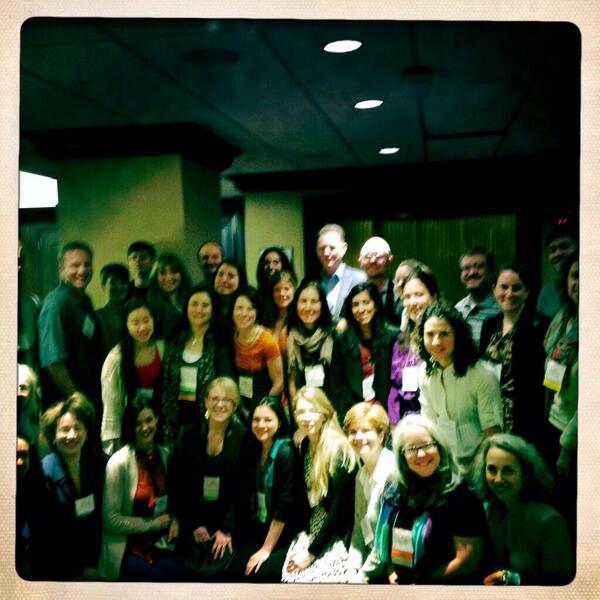
Here's a picture of the Academy's social media committee and frequent tweeters, who passed along tons of good content throughout the event:
If you want to read ALL our tweets (it's as if you were there!), check out #ICED2014 on Twubs.
My favorite event was a plenary entitled, "Adolescents and the Media: The Good, The Bad, and the Ugly."
So, long story short, the media doesn't cause eating disorders, but the 10-plus hours a day (reported by Mediatrician, Dr. Michael Rich) of media that teens are currently consuming certainly don't help. Eating disorders are complicated illnesses with various causal factors. Sociocultural influences can trigger eating disorders in those biologically/genetically susceptible, as well as disordered thought patterns and behaviors in the general population (which, as research shows, can sometimes morph into clinical pathology). We saw several examples of this in our plenary.
Kristina Saffran, a 21-year-old Harvard student wowed a roomful of 1000+ professionals with her inspiring talk about recovery and the birth of her nonprofit. Saffran is co-founder of Project Heal, an organization designed to increase awareness about eating disorders, as well as access to treatment - the foundation offers scholarships to those who don't have the means to finance treatment themselves. Part of Saffran's motivation to create Project Heal occurred out of her use of social media in her own recovery - what she found as she attempted to connect with others recovering online was a host of triggering images, updates, and comments. Saffran wanted to establish a space that was more recovery-oriented for those leaving treatment and needing ongoing, positive support.
Anne Becker, an anthropologist and psychologist who conducted the classic Fiji study, also spoke at this event. The Fiji study demonstrated the significant influence of media access on disordered eating and body-image disturbances. In a three-year period during which Fijian subjects first got access to television, the island nation witnessed rapid decreases in body image measures among teens, and researchers also documented a substantial increase in purging to manage weight among these same girls.
Phillippa Diedrichs, a health psychology researcher, spoke about some increasing efforts toward diversity in modeling/advertising (which still have ways to go), and discussed research around Photo-shopping/retouching on body image. My favorite point from her? We can "become the media" through our informed and relentless use of social media.
So, let's use this as a call to action and just as Saffran has done, and as I've attempted to do with this blog, find a way to use media actively and responsibly. We can counter the hoards of pernicious content available today by offering healthy, positive alternatives. Be active on social media to change the climate. We need your help.
Monday, March 24, 2014
Facebook and Disordered Eating
A recent study suggested that high levels of Facebook use are associated with an increased risk for eating disorders. The study, out of Florida State University, was published in a recent issue of the International Journal of Eating Disorders.
Why is it that spending more time on Facebook could increase disordered eating? Check out some of my theories here. Can you think of any others?
Still, let's not throw out the baby with the bathwater. Facebook, and other forms of social media, can be used for good, too.
Body image/eating disorder warrior Claire Mysko makes the case for social media as a advocacy tool in a response article here.
As Mysko writes: "Social media can stoke body dissatisfaction and reinforce disordered eating. It can also empower individuals to use their voices and resist mainstream media messages about beauty and thinness. Let's keep working to understand the nuances of those risks and leverage the benefits to build a movement of change."
So, as with most other concepts, Facebook is neither all good nor all bad when it comes to eating disorders. If you find that your Facebook use is resulting in destructive thoughts and behaviors, it might be time to scale back your use. You might also choose to like some body positive sites to counteract the hoards of other posts and advertisements celebrating restrictive eating, overexercising, and the thin ideal that make their way across your feed each day.
Why is it that spending more time on Facebook could increase disordered eating? Check out some of my theories here. Can you think of any others?
Still, let's not throw out the baby with the bathwater. Facebook, and other forms of social media, can be used for good, too.
Body image/eating disorder warrior Claire Mysko makes the case for social media as a advocacy tool in a response article here.
As Mysko writes: "Social media can stoke body dissatisfaction and reinforce disordered eating. It can also empower individuals to use their voices and resist mainstream media messages about beauty and thinness. Let's keep working to understand the nuances of those risks and leverage the benefits to build a movement of change."
So, as with most other concepts, Facebook is neither all good nor all bad when it comes to eating disorders. If you find that your Facebook use is resulting in destructive thoughts and behaviors, it might be time to scale back your use. You might also choose to like some body positive sites to counteract the hoards of other posts and advertisements celebrating restrictive eating, overexercising, and the thin ideal that make their way across your feed each day.
Monday, March 17, 2014
And Every Man, Too?
You might think that in writing this blog, I think that only women are afflicted with eating disorders. Not so.
The reality is that men, too, suffer from eating disorder and body image problems, and they seem to be closing the gap in the gender discrepancy we previously knew - or thought we knew.
A number of people and organizations are getting loud about the problem in eating disorders in men. One is Sam Thomas, the founder of director of Men Get Eating Disorders Too, a UK-based charity designed to raise awareness and provide support to men with eating disorders.
Recently, Thomas wrote an article* dedicated to Jeremy Gillitzer, whom he credits as helping him inspire him to found his organization. In the article, Thomas mentions that Gillitzer lost his life to his eating disorder (in 2010 at age 38).
Reading this article struck me like a ton of bricks. I remember Jeremy posting in these circles back in my early blogging days. I remember reading his story and seeing his pictures and, to be one hundred percent honest, thinking to myself, "This guy is going to die." And sadly, he did. I disclose this with a sense of helplessness and regret that none of us were able to bolster Jeremy in fighting this disease.
So, be clear, as Thomas says, men get eating disorders, too. They may not get treatment as frequently or quickly as women because of the shame associated with having a traditionally "female" disorder and because they fly under the radar of professionals and the world around them, but it is imperative that we support and take action on behalf of all of our brothers in need.
*Note: There is a picture of Jeremy at the bottom of the article (in his illness) that may be triggering and/or difficult to view.
The reality is that men, too, suffer from eating disorder and body image problems, and they seem to be closing the gap in the gender discrepancy we previously knew - or thought we knew.
A number of people and organizations are getting loud about the problem in eating disorders in men. One is Sam Thomas, the founder of director of Men Get Eating Disorders Too, a UK-based charity designed to raise awareness and provide support to men with eating disorders.
Recently, Thomas wrote an article* dedicated to Jeremy Gillitzer, whom he credits as helping him inspire him to found his organization. In the article, Thomas mentions that Gillitzer lost his life to his eating disorder (in 2010 at age 38).
Reading this article struck me like a ton of bricks. I remember Jeremy posting in these circles back in my early blogging days. I remember reading his story and seeing his pictures and, to be one hundred percent honest, thinking to myself, "This guy is going to die." And sadly, he did. I disclose this with a sense of helplessness and regret that none of us were able to bolster Jeremy in fighting this disease.
So, be clear, as Thomas says, men get eating disorders, too. They may not get treatment as frequently or quickly as women because of the shame associated with having a traditionally "female" disorder and because they fly under the radar of professionals and the world around them, but it is imperative that we support and take action on behalf of all of our brothers in need.
*Note: There is a picture of Jeremy at the bottom of the article (in his illness) that may be triggering and/or difficult to view.
Monday, March 10, 2014
Surfer Girl

On a beach walk one morning, two groups of children caught my eye. The first was a group of boys, with a fairly large age range, maybe 6-16. They were little surfers, hitting the morning Pacific waves with spirited tries.
Next I came across a smaller group of tween girls participating in a makeshift photo shoot. Clad in cute tops and short shorts, hair and make-up done, they jumped in the air and splashed in the surf, flirting with the photographer, while the sand-mounted camera flickered away.
Encountering these two groups of kids cemented for me how differently we socialize our children to be in this world. We tell our sons to be active and have fun, our daughters to look flirty and be cute. Boys are taught to do; girls are taught to be. And it's not surprising that so many girls grow up to have body image and self-esteem concerns, as we all but coach them to equate their identity with their appearance.
But each one of us can do something about this now. If you have a daughter or niece or favorite little girl in your life, teach her to surf. Teach her to climb trees, sing loud, ride bikes, chase the moon, and get dirty on a Sunday afternoon. Teach her that she's capable of doing and learning and being a presence, rather than just an image, in this world. She might cast a glance at a camera every once in a while, but she'll be too busy to look for long.
Tuesday, March 04, 2014
Book Review - Making Peace with Your Plate
"No one tells you that eating disorders are ugly," says Robyn Cruze, co-author of Making Peace with Your Plate: Eating Disorder Recovery. "When I was enmeshed in my eating disorder, I felt the opposite. I believed it would keep me safe and in control, and make me desirable. I thought it would protect me from myself."
So, how does the balance shift for Cruze? Eventually she finds motivation for change in the desire for freedom: "I so desperately wanted to experience life without the shackles of my eating disorder. I wanted to live, not just survive." At one point, Cruze declares: "My need to recover eventually became greater than my need to be thin." In my mind, this one pithy line captures recovery to a tee - almost everyone I've worked with has had a similar type of shift that ultimately drove her toward change.
As part of her journey, Cruze meets Espra Andrus, LCSW, a therapist trained in DBT. Though their time together was brief, Cruze was so moved by their meeting that she sought out Andrus to help her co-write this book. The result is a back-and-forth narrative that alternately captures Cruze's story with Andrus's clinical wisdom.
One of the best aspects to this book is the many exercises that help readers challenge their eating disorder voices with the truth, a common cognitive therapy technique and useful externalization of the eating disorder.
Here's one example:
Eating disorder: "There is no better way to get off of a spinning merry-go-round than to hang out with me."And another:
Truth: It is true that getting lost in eating-disorder thoughts and/or behaviors makes the chaos of things whirling around you disappear. The problem is that the merry-go-round hasn't actually stopped. You just close your eyes."
Eating disorder: "Honest, I really do help. I number the pain. Numbing pains the secret to life. . . and you need me."Andrus also provides specific techniques designed to aid in the recovery process. For instance, she encourages readers to make a list of potentially triggering comments from others (e.g., "You've lost some weight, you look good") and then "For each of these triggering words or phrases, write down what you might say, not say, do, or not do, when you hear them, then practice saying your responses out loud." As anyone in recovery can tell you, being prepared for these conversational challenges can go a long way.
Truth: Yes, your eating disorder serves as a quick fix for hard emotions - before it takes everything from you. And it will take everything from you.
Now recovered, Cruze reports: "The true value of recovery is in the process of "checking in" with myself and honoring that voice that longs to be heard and that encourages me to keep moving forward. And with each positive action I take toward this, I secure a little more self-worth from deep within."
What an inspirational definition of recovery. . .
Friday, February 28, 2014
Eating Disorder Memoirs: Helpful or Harmful?
What do you think?
The Academy for Eating Disorders is hosting a Twitter Chat on 3/13 (5pm EST) entitled, "Eating Disorders: Helpful or Harmful?" According to the blurb:
If you'd like to join, just follow these instructions provided by AED:
The Academy for Eating Disorders is hosting a Twitter Chat on 3/13 (5pm EST) entitled, "Eating Disorders: Helpful or Harmful?" According to the blurb:
Eating disorder memoirs have received significant attention as of late. Some diagnosed with eating disorders find writing and sharing their story helpful in the process of their recovery. But are these stories beneficial to their target audience? If you have an eating disorder, does reading eating disorder memoirs provide guidance on recovery and pocket support? Or, can reading these stories trigger increased eating-disorder behavior? AED takes a careful look at the pros and cons of eating disorder memoirs with the help of guests Carrie Arnold and Dr. Jennifer Thomas, in a lively chat you won't want to miss.On behalf of the Academy's Social Media Committee (@aedweb), I'll be asking our guests some thought-provoking questions, and the discussion promises to be an engaging one.
If you'd like to join, just follow these instructions provided by AED:
It's easy to join in the chat! - Try it!1. Go to www.tweetchat.com2. Enter the name of the chat: #AEDchatWould love to see you all there!
3. Next, read the posts and/or sign in to add your tweets.
Note: If you're tweeting, Tweetchat will add the chat hashtag (#AEDchat) each time for you.
Don't have Twitter account yet? You can create one here. You'll then be ready to follow the AED Twitter chat using hashtag #aedchat.
Tuesday, February 25, 2014
"She Doesn't Need to See the Menu"
Check out "She Doesn't Need to See the Menu" by Blythe Baird.
Baird uses words in phenomenal ways.
*Note: The poem may be a bit triggering for some.
Baird uses words in phenomenal ways.
*Note: The poem may be a bit triggering for some.
Thursday, February 06, 2014
The Biggest Eating Disorder?
The Biggest Loser winner Rachel Frederickson has made waves across the nation with her 155-pound weight loss. Frederickson dropped about a pound a day, a loss more rapid than any health professional would advise, and landed herself south of a healthy BMI.
Many have criticized Frederickson's new physique, calling her "unhealthy" or "anorexic." Truth be told, we know nothing of her health or eating disorder status. We do know that it isn't healthy to drop such a large amount of weight in a short period time (regardless of starting and ending weight), but we don't know where Frederickson falls on various health metrics.
But let's zoom out a bit. . . .
In our culture, we seem to stand on the sidelines, cheering weight loss among celebrities, fat reality show contestants, personal contacts, etc. It's as if we chant, "Thinner, thinner, thinner!" until, "Oops, too thin." I've seen this happen with a number of stars and hear it constantly in my work and in the world around me.
Millions of people watch TBL and cheer unhealthy weight loss methods until, oops, someone takes it a bit too far. But Frederickson was just playing the game well. This is a show that is predicated upon an eating disorder. It's a show that demands over-(compulsive) exercise and a very low calorie diet. It's a show that encourages weight stigma and fat shaming. And it's a show that gives the not-so-subtle message that it doesn't matter what you do, as long as you lose weight.
Just recently, trainer Jillian Michaels was slapped on the wrist for supplying her team with caffeine supplements in her quest to get them thin. Would you consider Adderall or cocaine, Jillian, if it meant securing the win? Where do you draw the line?
In the pursuit of skinny, lines are blurred and health is relegated to back-burner status. The only reason Frederickson's possibly unhealthy loss has garnered so much attention is that she happens to look so gaunt. As prior TBL contestants have revealed, the show promotes disordered behavior and unhealthy measures. Just because other contestants haven't dropped to Frederickson's low doesn't mean that they haven't compromised their physical and psychological health as a result of their participation on the show.
Michaels and fellow trainer Bob Harper declined to comment on Frederickson's weight loss, but as a personal trainer, I will. Frederickson's weight loss is unhealthy, as is the other contestants'. It's accomplished via destructive and humiliating behaviors and beliefs, and it lands a sucker punch on America's self-esteem. I can't even tell you how many people have ended up on my therapeutic couch who begin their story with some variation of, "I lost a lot of weight when following a personal trainer's diet and exercise guidelines."
Leslie Goldman, author of The Locker Room Diaries, thinks that Frederickson's weight loss "sets the body image movement back." I think the show itself, and its celebrated place in our culture, proves we still have work to do.
Many have criticized Frederickson's new physique, calling her "unhealthy" or "anorexic." Truth be told, we know nothing of her health or eating disorder status. We do know that it isn't healthy to drop such a large amount of weight in a short period time (regardless of starting and ending weight), but we don't know where Frederickson falls on various health metrics.
But let's zoom out a bit. . . .
In our culture, we seem to stand on the sidelines, cheering weight loss among celebrities, fat reality show contestants, personal contacts, etc. It's as if we chant, "Thinner, thinner, thinner!" until, "Oops, too thin." I've seen this happen with a number of stars and hear it constantly in my work and in the world around me.
Millions of people watch TBL and cheer unhealthy weight loss methods until, oops, someone takes it a bit too far. But Frederickson was just playing the game well. This is a show that is predicated upon an eating disorder. It's a show that demands over-(compulsive) exercise and a very low calorie diet. It's a show that encourages weight stigma and fat shaming. And it's a show that gives the not-so-subtle message that it doesn't matter what you do, as long as you lose weight.
Just recently, trainer Jillian Michaels was slapped on the wrist for supplying her team with caffeine supplements in her quest to get them thin. Would you consider Adderall or cocaine, Jillian, if it meant securing the win? Where do you draw the line?
In the pursuit of skinny, lines are blurred and health is relegated to back-burner status. The only reason Frederickson's possibly unhealthy loss has garnered so much attention is that she happens to look so gaunt. As prior TBL contestants have revealed, the show promotes disordered behavior and unhealthy measures. Just because other contestants haven't dropped to Frederickson's low doesn't mean that they haven't compromised their physical and psychological health as a result of their participation on the show.
Michaels and fellow trainer Bob Harper declined to comment on Frederickson's weight loss, but as a personal trainer, I will. Frederickson's weight loss is unhealthy, as is the other contestants'. It's accomplished via destructive and humiliating behaviors and beliefs, and it lands a sucker punch on America's self-esteem. I can't even tell you how many people have ended up on my therapeutic couch who begin their story with some variation of, "I lost a lot of weight when following a personal trainer's diet and exercise guidelines."
Leslie Goldman, author of The Locker Room Diaries, thinks that Frederickson's weight loss "sets the body image movement back." I think the show itself, and its celebrated place in our culture, proves we still have work to do.
Monday, January 13, 2014
Why I Choose to Eat Intuitively and How You Can, Too
A friend visited weeks ago and asked how I don't go overboard on all the treats I have stocked in my kitchen cupboard (when she visits, she does a self-acknowledged mini-raid). "How is it that you're not always eating this stuff?" she wondered, and I replied, "Because it's always here."
When you decide to loosen the rules around food restriction, it's surprising how the forbidden fruit becomes just fruit.
Another friend was visiting recently and while we were gabbing in the kitchen, I grabbed a few cookies from the counter.
My friend interrupted her own speech and said, "That's so great that you can grab a handful of cookies and not feel bad about it in the morning."
I paused, as I digested what she was saying. She assumed that I don't regret my food choices in the morning, but she was actually right. My pause, however, was more about the reality that anyone can make this choice, to eat dessert without guilt. I don't have special powers. What I do have is an intention to have a healthy relationship with food. I've decided that for me, enjoying food is more important than fitting into the jeans I wore in my twenties. I could probably do that if I really, really restricted my diet, but it's just not worth it to me.
Drew Barrymore seems to feel the same. The actress, gearing up to be a second-time mom, reflected on food, weight, and body image in an issue of Allure magazine: "I cannot live a life where I"m deprived. I'd much rather be five, 10 pounds heavier." Barrymore went on, "With my luck, I'll get myself to that perfect goal weight, and I'll get hit by a bus. Then, I'll be like. . . looking at myself from some afterlife going, 'You idiot. You could have had that agnolotti, dummy.'"
I love the freedom of eating intuitively. I love the freedom of not thinking about food all the time. So, the jeans from years ago, well, they just had to go.
When you decide to loosen the rules around food restriction, it's surprising how the forbidden fruit becomes just fruit.
My friend interrupted her own speech and said, "That's so great that you can grab a handful of cookies and not feel bad about it in the morning."
I paused, as I digested what she was saying. She assumed that I don't regret my food choices in the morning, but she was actually right. My pause, however, was more about the reality that anyone can make this choice, to eat dessert without guilt. I don't have special powers. What I do have is an intention to have a healthy relationship with food. I've decided that for me, enjoying food is more important than fitting into the jeans I wore in my twenties. I could probably do that if I really, really restricted my diet, but it's just not worth it to me.
Drew Barrymore seems to feel the same. The actress, gearing up to be a second-time mom, reflected on food, weight, and body image in an issue of Allure magazine: "I cannot live a life where I"m deprived. I'd much rather be five, 10 pounds heavier." Barrymore went on, "With my luck, I'll get myself to that perfect goal weight, and I'll get hit by a bus. Then, I'll be like. . . looking at myself from some afterlife going, 'You idiot. You could have had that agnolotti, dummy.'"
I love the freedom of eating intuitively. I love the freedom of not thinking about food all the time. So, the jeans from years ago, well, they just had to go.
Tuesday, December 31, 2013
Resolutions
To start the year off on a positive note, avoid resolutions in the spirit of self-dislike. Rather than focusing on weight loss, why not resolve to improve your relationship with food, and while you're at it, your relationship with your body? This will help you now and will last way beyond the crash-diet/gym-heavy January norm.
Other ideas for resolutions:
Other ideas for resolutions:
- Develop a healthier relationship with exercise
- Improve self-acceptance
- Practice imperfection
- Accept yourself as is, while still leaving room for change and growth
Happy New Year.
Monday, December 16, 2013
Truth in Advertising
Have you seen the new Special K campaign that encourages us to put an end to Fat Talk?
So inspirational, right? Except that the video tells us that fat talk is a barrier to managing our weight, rather than a barrier to being happy or being alive. . . And this is the same Special K that asked us "What will you gain when you lose?", that promised us we could drop a jean size in two weeks, and that introduced us to weightless Melissa. Remember her?
Pantene is responsible for a simultaneous viral campaign that encourages us to buck the women-as-bossy or-bitchy stereotype and lean in just like Sheryl.
But is Pantene really after our best interests? In a Time article, research psychologist Peggy Drexler asks: "After all, is there anything more sexist than the notion that professional women need a hair care brand—or anyone, really—to help them learn to 'be strong and shine'?" Keep in mind, this is the same Pantene of the 1980's "Don't hate me because I'm beautiful" campaign. Remember her?
Unilever's Dove "Real Beauty" campaign was perhaps the first to market with the purpose of body positivity. But in these ads, which aimed to cast "flawless" women, we saw gradations of thin, curvy physiques with spotless skin and beautiful hair. This is the same Unilever that owns Slim Fast.
These companies don't really care if you love your body or achieve your personal or career goals. If so, they would have built themselves around this philosophy from the start. They want you to buy their products. Consultants have advised them that the route to enviable sales now lies in promoting self-empowerment. So they are. But body love and personal growth are independent of cereal, body wash, and shampoo selection, and these campaigns are hypocritical at worst, see through at best. Don't believe the hype.
So inspirational, right? Except that the video tells us that fat talk is a barrier to managing our weight, rather than a barrier to being happy or being alive. . . And this is the same Special K that asked us "What will you gain when you lose?", that promised us we could drop a jean size in two weeks, and that introduced us to weightless Melissa. Remember her?
Pantene is responsible for a simultaneous viral campaign that encourages us to buck the women-as-bossy or-bitchy stereotype and lean in just like Sheryl.
But is Pantene really after our best interests? In a Time article, research psychologist Peggy Drexler asks: "After all, is there anything more sexist than the notion that professional women need a hair care brand—or anyone, really—to help them learn to 'be strong and shine'?" Keep in mind, this is the same Pantene of the 1980's "Don't hate me because I'm beautiful" campaign. Remember her?
Unilever's Dove "Real Beauty" campaign was perhaps the first to market with the purpose of body positivity. But in these ads, which aimed to cast "flawless" women, we saw gradations of thin, curvy physiques with spotless skin and beautiful hair. This is the same Unilever that owns Slim Fast.
These companies don't really care if you love your body or achieve your personal or career goals. If so, they would have built themselves around this philosophy from the start. They want you to buy their products. Consultants have advised them that the route to enviable sales now lies in promoting self-empowerment. So they are. But body love and personal growth are independent of cereal, body wash, and shampoo selection, and these campaigns are hypocritical at worst, see through at best. Don't believe the hype.
Monday, December 09, 2013
Fatness: A Public Health Crisis?
Hey Tweet Peeps,
Do you have plans for Friday, December 13th, at 1pm EST?
If not, join the Academy for Eating Disorders' upcoming TweetChat! We will be hosting UCLA sociology professor and author Dr. Abigail Saguy, who wrote the book, What's Wrong With Fat? released earlier this year. (Hint: Buy it--it's good!)
I'm honored to be helping out with the TweetChat behind the scenes. You can follow the buzz using #aedchat or the handles @aedweb, @WhatsWrongWithFat, or mine, @drstaceyla.
Enjoy the dialogue!
Do you have plans for Friday, December 13th, at 1pm EST?
If not, join the Academy for Eating Disorders' upcoming TweetChat! We will be hosting UCLA sociology professor and author Dr. Abigail Saguy, who wrote the book, What's Wrong With Fat? released earlier this year. (Hint: Buy it--it's good!)
Enjoy the dialogue!
Monday, November 18, 2013
My Thoughts on Lululemon
Last week, yoga/fitness/lifestyle clothier Lululemon's founder Chip Wilson made a huge body image/weight stigma blunder by refusing to take any responsibility when accused of poor product construction. Instead, he blamed yoga pant pilling on poorly constructed women. "Some women's bodies just actually don't work," he said. "It's about the rubbing through the thighs." It's not the fabric's fault, silly; it's your bulging gams.
Wilson has apologized publicly for the offense, but many in the eating disorder community just won't have it. Body Image Advocate Marci Warfhaft-Nadler makes some excellent points here and also started a change.org petition encouraging Lululemon founder Chip Wilson to "stop shaming women's bodies" and "apologize and make clothes for women of all sizes!"
In defense of Lululemon, I happen to like their products, swayed early on by the brand's comfort, fit, and seeming impermeability to sweat smells and stains.* Granted, unlike the average American woman, I wear a size that entitles me to shop at Lululemon in the first place, but in my experience, their yoga and running pants actually pill less than other brands. And, for those of you who have never seen me, I'm sans thigh gap and not even close to a top-shelf Lululemon'er. And yet, my trusted Lulus have held up over
time. . .
Wilson made an offensive comment and for that, he should take responsibility, but let's hate the player and the game. Wilson's fat-shaming sentiment, and the brand's refusal to carry larger sizes, are not at all unique to Wilson or Lululemon. Rather, they are problems that plague the fashion industry and our culture as a whole. The conversation about bodies, clothing, and weight stigma goes way beyond Chip Wilson and Lululemon and must evolve, along with the industry, to be more inclusive and less offensive to all of us.
*Product plugs: I'm grateful to Lululemon, Nike, Hard Tail, New Balance, and Apple products for outfitting and entertaining me during today's morning workout, which allowed me the time and space to write this blog post in my head.
Wilson has apologized publicly for the offense, but many in the eating disorder community just won't have it. Body Image Advocate Marci Warfhaft-Nadler makes some excellent points here and also started a change.org petition encouraging Lululemon founder Chip Wilson to "stop shaming women's bodies" and "apologize and make clothes for women of all sizes!"
In defense of Lululemon, I happen to like their products, swayed early on by the brand's comfort, fit, and seeming impermeability to sweat smells and stains.* Granted, unlike the average American woman, I wear a size that entitles me to shop at Lululemon in the first place, but in my experience, their yoga and running pants actually pill less than other brands. And, for those of you who have never seen me, I'm sans thigh gap and not even close to a top-shelf Lululemon'er. And yet, my trusted Lulus have held up over
time. . .
Wilson made an offensive comment and for that, he should take responsibility, but let's hate the player and the game. Wilson's fat-shaming sentiment, and the brand's refusal to carry larger sizes, are not at all unique to Wilson or Lululemon. Rather, they are problems that plague the fashion industry and our culture as a whole. The conversation about bodies, clothing, and weight stigma goes way beyond Chip Wilson and Lululemon and must evolve, along with the industry, to be more inclusive and less offensive to all of us.
*Product plugs: I'm grateful to Lululemon, Nike, Hard Tail, New Balance, and Apple products for outfitting and entertaining me during today's morning workout, which allowed me the time and space to write this blog post in my head.
Tuesday, November 05, 2013
FLOTUS on TBL?
You may have heard that Michelle Obama is scheduled to appear (again) on an episode of NBC's The Biggest Loser.
This time, the eating disorder community won't go down without a fight.
The last couple of weeks have witnessed a social media* blitz suggesting our first lady reconsider her appearance. The folks over at Binge Behavior started a change.org petition encouraging Mrs. Obama to cancel on TBL. The petition already has 3,500 signatures, including mine!
Binge Behavior, together with the Binge Eating Disorder Association, the Academy of Eating Disorders and some other key e.d. players, also sent a letter to Mrs. Obama explaining why we are challenging her appearance on the show.
What do you think?
*Speaking of social media, a couple of months ago, I signed on as one of the official Tweeters for the Academy of Eating Disorders. For great content on eating disorders, check out their Twitter feed: @aedweb (and mine, too: @drstaceyla)!
This time, the eating disorder community won't go down without a fight.
The last couple of weeks have witnessed a social media* blitz suggesting our first lady reconsider her appearance. The folks over at Binge Behavior started a change.org petition encouraging Mrs. Obama to cancel on TBL. The petition already has 3,500 signatures, including mine!
Binge Behavior, together with the Binge Eating Disorder Association, the Academy of Eating Disorders and some other key e.d. players, also sent a letter to Mrs. Obama explaining why we are challenging her appearance on the show.
What do you think?
*Speaking of social media, a couple of months ago, I signed on as one of the official Tweeters for the Academy of Eating Disorders. For great content on eating disorders, check out their Twitter feed: @aedweb (and mine, too: @drstaceyla)!
Wednesday, October 16, 2013
No Excuses

By now, you've probably seen this photo (motivational campaign?), which has quickly made the internet rounds.
Maria Kang is, as she describes on her website, a "recovering bulimic." I would hope that all women in recovery understand that images and messages like this are often difficult for women, with and without eating disorders, to tolerate.
The word "excuse" has a judgmental, shaming connotation to it. If you're not doing it her way, then clearly, you're not doing it right. Already, many women have spoken out with their "excuses," from lack of time or other resources, to serious illness. How's cancer for an excuse for not rocking Kangian abs?
The reality is, most women's "excuse" is simply genetics. Even if they spent three hours daily at the gym (and really, how healthy would that be?) and ate only unprocessed, organic, vegan, dairy-free, sugar-free, gluten-free morsels at two-hour intervals throughout the day, stopping by 7pm, of course (and really, how healthy would that be?), they still wouldn't look like this. Because their genes just don't want them to. Their bodies would rebel from over-training by getting sick and injured and they would compensate for caloric restriction by overeating or bingeing when given the chance. And their lives would be monumentally out of balance. . .
There are hoards of athletic, flexible, strong, in-shape women who can run marathons or climb mountains, hoist dumbbells, office printers, or six-year-olds, who earn cardiovascular and metabolic gold stars at each and every doctor's visit, who look nothing like this. The reality is, by looking at the photo of Kang, we can't even know if she's healthy. We simply know that she's thin. The more we equate health with appearance, the more we encourage exercise as punishment (rather than life-affirming recreation) and promote cultural-sanctioned disordered eating and body dissatisfaction.
And until women can come together and stop judging, criticizing and attacking one another, we really don't stand a chance in tackling the many forms of competition and adversity we experience in our roles as mothers, in the workplace, as sexual objects, etc., etc., etc.
Motivating people through judgment, shame, and attack isn't motivating, at least not in the long-run. My hope is that women like Kang can motivate her fitness audience through accurate information, encouragement, and support. There are plenty of forces and factors in this world that denigrate women; let's at least call it a truce with one another.
Tuesday, October 08, 2013
Should She Rebel?
It looks like Aussie export Rebel Wilson is getting the full-court press by the diet industry, as companies bid to have her crowned their newest weight-loss spokesperson.
Wilson, praised for her comedic talent and now the star of her own show, is apparently set to encounter tons of money if she signs on to endorse one of these plans.
Should she do it for the money (who's the biggest loser, then?) or say no, I'm happy and successful the way I am?
Wilson, praised for her comedic talent and now the star of her own show, is apparently set to encounter tons of money if she signs on to endorse one of these plans.
Should she do it for the money (who's the biggest loser, then?) or say no, I'm happy and successful the way I am?
Friday, September 20, 2013
Is Strong the New Skinny?
I remember the first "Fitspiration" ad I clipped many years ago. It was a print ad from Nike, and the rookie fitness professional in me liked the message. It said something to the effect of how we never go out for a run and later regret that we did. Couldn't really argue that. . .
Flash forward almost 20 years and these ads have morphed into something entirely different.
Nike still plays it relatively safe, but commands hard work and harder bodies.
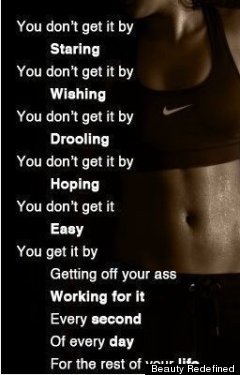
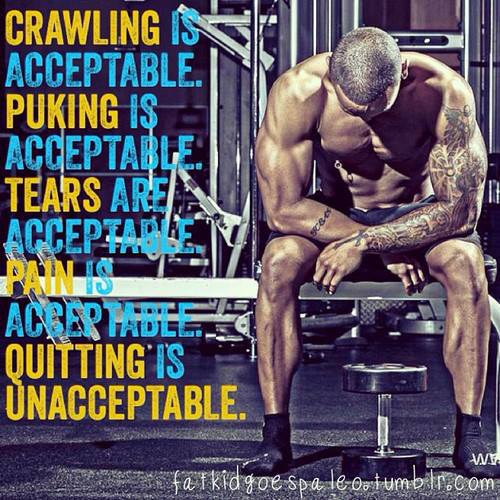
Others have a more radical tone. Following in the footsteps of thinspiration, fitspiration (nicknamed "fitspo"), offers internet images and slogans designed to motivate us toward our fitness goals. Popping up on social media sites are images of women with toned, muscular bodies and especially chiseled abs accompanied by inspirational messages evoking themes of discipline, failure, and pain.




Flash forward almost 20 years and these ads have morphed into something entirely different.
Nike still plays it relatively safe, but commands hard work and harder bodies.
Others have a more radical tone. Following in the footsteps of thinspiration, fitspiration (nicknamed "fitspo"), offers internet images and slogans designed to motivate us toward our fitness goals. Popping up on social media sites are images of women with toned, muscular bodies and especially chiseled abs accompanied by inspirational messages evoking themes of discipline, failure, and pain.
Charlotte Anderson of the blog (and book), The Great Fitness Experiment, writes about fitspo:
Looking at rock-hard body after rock-hard body it occurred to met hat fitspo may be in thinspo in a sports bra. After all ,the problem with thinspo is that the images represent a mostly unattainable ideal that requires great sacrifices (both physical and mental) to achieve and I daresay that most of those "perfect" female bodies, albeit muscular instead of bony, are equally as problematic.What do you think? Do fitspo images and slogans motivate fitness behavior in the masses or promote an unhealthy relationship with exercise, food, and weight? Are these ads just more socially acceptable forms of thinspo?
Strong is certainly a healthier goal than skinny, and I'd love to see images of strong women of various shapes and sizes. But if strong really is the new sexy, then why are these women all so skinny?
Friday, September 13, 2013

Monday, August 26, 2013
Calling All Commenters!
I'm excited to announce that my blog has
generated interest from a publisher to create a book on the important subject
of eating/body image concerns. Through the years the comments from readers have been an
important part of this blog. If you have commented at any time, I would
appreciate your contacting me at drstaceyla at gmail dot com. Thank you.
Tuesday, August 20, 2013
Like a Lady?
The Skinny Girls Cocktails website commands:
Ladies, it’s time. Time to bring the old rules of cocktailing into the modern age. Time to re-write the books on the way we socialize. Time to redefine just what it means to be a lady. Sure, a lady always says, “please” and “thank you,” but a lady also knows what she wants, and isn’t afraid to go out and get it. And Skinnygirl® Cocktails is here to show you how. It’s a woman’s world out there, and it’s time to Drink Like a Lady™.What exactly does it mean to "drink like a lady"? Does it mean that you sit cross-legged on a chaise, sipping your chardonnay? That your pinkie dangles delicately as you drink your daiquiri?
Does it mean you wisely moderate your alcohol use? (Now that's a cause I can get behind!)
Or, does it mean, as implied by the brand name, that you imbibe liberally but still look like Bethenny?
It's a tiring (and tiresome) dilemma for women. Enjoy your food, but watch your weight. Glisten, but don't you sweat. Be sexual, but not promiscuous.
If it really were a "woman's world," would you have to "drink like a lady" or could you simply drink?
Monday, August 12, 2013
Attention Long-time Readers!
Remember when I posted years ago asking for story submissions? For those of you who so kindly sent me your stories, would you please send me your updated contact info? (to drstaceyny AT gmail DOT com). I'd like to get formal permission to use them for the book.
Others: want to share your story with the world? Feel free to send to me!
Also, check out my new list of links (Sites I Like) to the right for helpful content on eating disorders, food, and weight.
And, for those who want a good laugh, check out this video, courtesy of Amy Schumer, which addresses in hyperbolic fashion how many women just can't seem to take a compliment (apologies for the profanity).
Others: want to share your story with the world? Feel free to send to me!
Also, check out my new list of links (Sites I Like) to the right for helpful content on eating disorders, food, and weight.
And, for those who want a good laugh, check out this video, courtesy of Amy Schumer, which addresses in hyperbolic fashion how many women just can't seem to take a compliment (apologies for the profanity).
Monday, July 08, 2013
You Are Beautiful. . . Or Does it Even Really Matter?

The sign beckons me from a parking lot in Santa Monica. You are beautiful, it says. And for a moment, I agree. I am beautiful. And so are you. And you. And yes, even you.
It's such a, well, beautiful sentiment. We should all acknowledge how uniquely beautiful we are.
For years, I've worked within this framework, encouraging women to focus on what aspects of their appearance they like. For some, even finding one or two features was a difficult task, but I was patient and resolute. For me, it was important to recognize that appearance isn't a black-and-white issue, and that while you might not like your stomach, your eyes, well, they're kinda pretty, no?
And, zooming out a bit, aren't you really just a beautifully complete creature, a perfect constellation of limbs, organs, fluid, and cells, parts that fit and function in a miraculous way?
More recently, though, I've found myself shifting frames. If you feel beautiful, that's quite an accomplishment given our current cultural context. Good for you. You've outwitted them.
But if you don't, that might okay, too. Because, I'm interested in taking that current cultural context and slamming it into an empty parking lot wall. Why must we put such a premium on beauty? You're not so attractive? Okay. What do you have going for you that likely, in the scheme of things, matters significantly more? Beauty may get us through this world more quickly. I'm not going to argue that. It's like a theme park fast pass for life. But, if beauty is what you want out of life, and that's how you'll evaluate your time on earth as it nears it's end, then it's possible you have some larger challenges than the shape of your nose or the size of your thighs.
The ladies behind Beauty Redefined offer up some words of wisdom that reflect this change of course. You may argue, "No, that's not true," but isn't that just another sign that you've been brainwashed like the rest of us?

So, what do you think? Should we continue to stress "You are beautiful," or instead radicalize the discourse a la Beauty Redefined?
Thursday, May 23, 2013
Can You Love Your Body Without Really Loving Your Body?
Lose the Diet.


Love Your Body.
Eat in Peace.
Those are three of the major tenets of my work with eating and body image. The order in which women accomplish these goals is fairly standard. First, they give up dieting. While this may be a radical notion for some, usually it's not too difficult to accomplish. Next, and as a part of a new non-dieting approach, they learn to find peace with food. This step may require a bit more finagling, but many women are still able to find success. So far, so good. . . But, what comes next is, in my opinion, significantly more challenging to approach.
Love Your Body.
What does that mean? Do you really need to love your body to move beyond eating and body issues? Is love a requirement to heal?
I don't believe that you must really love your body in order to recover. The truth is that most women (and an increasing number of men these days) don't love their bodies. But, what is important is acting as if you love your body. What does that mean exactly?
- You refrain from attacking your body with verbal and visual assaults.
- You take care of your body, providing it with adequate nutrition, sleep, and other self-care behaviors.
- You exercise for health and enjoyment, not for punishment or compensation.
- You wear clothing that fits, is comfortable, and flatters your physique.
- You participate in activities that you enjoy, without letting your size keep you sidelined or from enjoying these activities.
- You have a healthy sexual/romantic life, and your body image isn't an obstacle to your sexuality.
- You treat your body well, and if finances allow, you go for massages, manicures, etc.
- You accept that while you might prefer to be thinner, taller, tanner, or more toned, this is your body now.
Can you try to act as if?
Monday, April 15, 2013
Developing a Healthy Relationship with Exercise
Exercise is a wonderful thing. Unfortunately, that's not the case for most people I know. It seems I'm usually either working with people to begin an exercise program or, on the other extreme, to back off of an exercise regime they don't enjoy but feel compelled to do. As a psychologist who specializes in eating/body issues, who also has a master's degree in sport/exercise psychology and has been certified as a personal trainer for over 15 years, I am uniquely positioned to comment on both sides of the exercise spectrum, from under-exercise to exercise addiction.
We know that a large percentage of people who begin an exercise program will drop out within the first six months. Why? Because they don't like what they're doing. Because they burn out. Because life gets in the way. If you follow these tips, though, you'll be more likely to commit to healthy activity over the long-haul because you'll actually enjoy what you're doing. Remember, the goal is to choose an "exercise lifestyle" that will work for the rest of your years.
1) Cross-train: Trainers have been talking for eons about the physiological benefits of cross-training, but cross-training has significant mental pros, too. Participating in different activities throughout the week (month or year) reduces emotional burnout.
2) Get outside: There's something about fresh air and the sights, smells and sounds of city/country living that can contribute to the psychological benefits of fitness. Nature, too, is a natural mood-booster. True, some may also enjoy the sights (maybe not the smells) of their local gym, but still, I recommend that, weather-permitting, you mix it up a bit.
3) Ban the gym: Speaking of the gym, consider your relationship with your local Gold's or Equinox. If you hate going there, it's going to be an uphill battle all the way, and chances are, you'll drop out. If the gym connotes discomfort, punishment, etc., choose another venue you actually look forward to visiting. Play tennis. Go hiking. Take salsa lessons. There is absolutely no need to go to the gym if that's not your thing. Adrenaline junkie? Try rock climbing, ocean swimming, mountain biking. You'd be impressed at how infinitely more thrilling chasing the speed limit cycling westbound on San Vincente in L.A. or on the downhill stretch of Harlem Hill in Central Park can be than parking yourself on the stationary bike at the gym.
4) Get your soundtrack on: Studies show that we'll work out longer and harder when accompanied by good music. I love my music collection so much that I look forward to the movement it commands. You, too, can create a personal dance party on your MP3 player. For more of a challenge, choose faster-paced music, as we unconsciously move our bodies to the beat.
5) Set goals: It's incredibly motivating to have a project or goal to work toward. Sign up for your first 5k (or muddy buddy race, if that's your thing). Join a summer basketball league, knowing that you'd like to be in fighting shape before the league begins. Having some sort of goal or deadline can enhance your fitness commitment and keep you on track.
6) Forget the weight: Exercise because it feels good and contributes to physical and psychological health, not because it burns calories or helps you lose or maintain weight. Those who begin exercise programs to lose weight often drop out when they don't see the immediate desired results. On the other extreme, exercise can become disordered as individuals seek to burn off each additional calorie they've consumed. Exercise is a privilege, not a punishment for consumption. I wish that all group fitness instructors would, in their prompts during class, focus on strength, health, and fun, rather than calories and weight. 15 years ago, I wrote my master's thesis on the mood-enhancing properties of exercise, and I still stand behind that research. Exercise results in reduced depression and anxiety and increased self-esteem. Work out with these significant benefits in mind.
7) Be consistent: Hemming and hawing about should I or shouldn't I work out today creates too much room for bailing. Have a set schedule that you commit to, unless you're sick or something urgent arises. Consider fitness to be a part of your everyday routine.
8) Take it easy: Yes, it is possible both to be consistent and to take it easy. Schedule days off. This one is particularly challenging for those who have a compulsive relationship with exercise, but for that reason alone, it's important to achieve. The body (and the mind) need some time to recover. Taking a couple of days off per week allows you to come back clearer, stronger, and more determined. Schedule weeks off here or there throughout the year to recover more fully and further increase your drive. Prove that you have a healthy relationship with exercise by taking time off for work/family obligations, travel, illness, surgeries, etc. without suffering guilt, anxiety, or depression.
9) Embrace the grays: Taking it easy also involves embracing the grays: Despite what almost everyone I work with believes, I still espouse that 15 minutes of exercise is better than nothing. If you don't have the time or energy to put it a full workout, do what you can. Trust me, it still counts. On a related note, your workout should not feel like 45 minutes of physical torture. Many people dislike exercise because they equate it with pain. Back off to a degree where you feel challenged, but not distressed. Especially if you're having an off day, give yourself permission to dial back the effort. Your run can turn into a walk, your kickboxing class into a yoga class class across the gym. And yes, it still counts.
10) Practice gratitude: Take a moment to remember how lucky you are to choose to move your body. Be thankful for functioning limbs, a healthy heart and lungs, and the lifestyle wherewithal that allows you to have the time, space, and energy to move.
Tuesday, March 26, 2013
Bumpy Roads
What do Kim Kardashian, Jessica Simpson, and Kate Middleton have in common? Yes, they're all famous, and yes, they're all pregnant, but all three have also been criticized for their pregnancy shape.
As if the physical and emotional aspects of pregnancy aren't enough stress to bear, women's pregnant bodies are constantly scrutinized and judged by others. Are you gaining enough weight? Are you gaining too much weight? Or are you the Goldilocks of motherhood?
For those who struggled with food prior to pregnancy, these 10 months can be exceptionally challenging. Morning sickness, weekly weight checks, a growing belly (and body. . . even despite a real and delicious purpose), sometimes well-intentioned comments about the "right" things to eat--all can rile up an already shaky relationship with food and weight. And, as more and more women are turning to fertility treatments these days, tack on additional pre-pregnancy gain.
A lot of this cannot be stopped. But the comments, they need to cease. Internet magazine Jezebel recently ran an article lambasting the media hoopla around Kim K's gain. I say, we need to apply these words to every expecting mother. Not one woman should be critically commenting on another woman's growing belly. It's the quickest, surest way to devalue the miracle of life.
A lot of this cannot be stopped. But the comments, they need to cease. Internet magazine Jezebel recently ran an article lambasting the media hoopla around Kim K's gain. I say, we need to apply these words to every expecting mother. Not one woman should be critically commenting on another woman's growing belly. It's the quickest, surest way to devalue the miracle of life.
Tuesday, March 05, 2013
I Recommend This Book to No One
Well, I found a book that I would like to recommend to no one.
I was browsing in my local novelty shop and came across this title:

Never have I been so disappointed by a subtitle. And to think, the title had such promise!
So, I found myself mentally rewriting the subtitle (and, of course, by extension, the book). Six Weeks to OMG: Never Pick Up a Diet Book Again. . . Six Weeks to OMG: Learn How to Challenge Current Media Representations of Women. . . Six Weeks to OMG: Finally Organize Your Sock Drawer. . . really anything than the one they chose.
How would you rename this book? What can you accomplish in six weeks that is healthier and more productive than the promise laid out here?
Tuesday, February 26, 2013
NEDAwareness Week

You do know that it's National Eating Disorder Awareness Week, right?
Check out NEDA's new graphics on eating disorders in men and women. Did you learn something new?
Here are my NEDAW plans:
1) This past weekend, I attended FBT training at Stanford University. What an informative weekend!
2) Yesterday, I attended this great talk on evidenced-based treatment.
3) On Friday, I kick off Sierra Tucson's Symposium for Eating Disorder Treatment (Remember those questions I asked you a while back about therapist preferences? I'll be drawing from your responses.) I'll be followed by a number of impressive names in the field.
4) On Saturday, I'm joining colleagues for the first-ever Los Angeles NEDA Walk!
What are you doing to move yourself and others along in recovery this week?
Are you talking the talk and walking the walk?
Tuesday, February 12, 2013
OA (Oh No?)
12-step programs have guided countless individuals to sobriety and recovery. I've worked with patients who fully attribute their substance abuse recovery to participation in "the rooms." While some patients never take to the fellowship, citing a variety of objections (e.g., don't like the idea of a higher power, feel the organization is cultish, etc.), many find these self-help groups to be helpful and supportive.
Do these same benefits translate to the world of overeating? Is Overeaters Anonymous helpful or hurtful?
We know that that there is something inherently addictive about alcohol and other drugs. With food, I'm not so sure. Despite plentiful claims in the popular media, we don't have any good research that suggests that "food addiction" exists. For an interesting summary on this debate, check out this dietitian's blog. We know that people can demonstrate an addictive relationship around food, but this doesn't mean that the food itself is addictive. Rather, behaviors like restriction and bingeing can be incredibly habit-forming.
Moreover, most of the foods that people label as addictive (e.g., sugar, carbohydrates, fats, etc.) are foods that they've tried to restrict in some ways. Deprivation can, as we know, lead to overeating. For instance, almost every patient I see who tells me she's addicted to sugar happens to be restricting her carbs. Once she supplements her carbohydrate intake, much of the sugar cravings subside.
The problem with OA is that many groups (not all, but many) conceptualize food or certain foods as addictive. As a solution, they preach abstinence (similar to other 12-step programs). OA members will speak of their abstinence from sugar, wheat, etc. Some OA sponsors will prescribe their sponsees specific meal plans. Any departure from the meal plan is considered a relapse (i.e., back to Day 1).
The problem with this approach, if you're not guessing this already, is that abstinence equals deprivation! As a result, many who try out OA, find themselves developing even greater problems with bingeing or overeating, as a result of the diet-binge cycle. We're able to carve out an existence without alcohol or drug. but abstinence from food is impossible and abstinence from certain foods increases the experience of deprivation. By defaulting to abstinence, OA does not teach members how to eat in moderation (which, in my opinion, is necessary to be functional around food in this world), contend with emotions that lead to overeating, or heal one's relationship with food. It only makes it worse. OA members may practice abstinence from various foods until a time in which they're presented with that food/can't take it any longer/give up. . . leading to one colossal binge. I've worked with a number of patients who come into treatment, precipitated by an increase in disordered eating, which they attribute to OA.
Now, it may be possible to find OA groups and/or sponsors that are less restrictive and offer the typical benefits associated with 12-step groups. But unless that's possible, those who struggle with compulsive eating may be better served through Anorexics and Bulimics Anonymous or emotional eating groups run by private practitioners who espouse a more intuitive approach to eating and food.
Thoughts?
*thanks to Meliss, who begged the question : )
Do these same benefits translate to the world of overeating? Is Overeaters Anonymous helpful or hurtful?
We know that that there is something inherently addictive about alcohol and other drugs. With food, I'm not so sure. Despite plentiful claims in the popular media, we don't have any good research that suggests that "food addiction" exists. For an interesting summary on this debate, check out this dietitian's blog. We know that people can demonstrate an addictive relationship around food, but this doesn't mean that the food itself is addictive. Rather, behaviors like restriction and bingeing can be incredibly habit-forming.
Moreover, most of the foods that people label as addictive (e.g., sugar, carbohydrates, fats, etc.) are foods that they've tried to restrict in some ways. Deprivation can, as we know, lead to overeating. For instance, almost every patient I see who tells me she's addicted to sugar happens to be restricting her carbs. Once she supplements her carbohydrate intake, much of the sugar cravings subside.
The problem with OA is that many groups (not all, but many) conceptualize food or certain foods as addictive. As a solution, they preach abstinence (similar to other 12-step programs). OA members will speak of their abstinence from sugar, wheat, etc. Some OA sponsors will prescribe their sponsees specific meal plans. Any departure from the meal plan is considered a relapse (i.e., back to Day 1).
The problem with this approach, if you're not guessing this already, is that abstinence equals deprivation! As a result, many who try out OA, find themselves developing even greater problems with bingeing or overeating, as a result of the diet-binge cycle. We're able to carve out an existence without alcohol or drug. but abstinence from food is impossible and abstinence from certain foods increases the experience of deprivation. By defaulting to abstinence, OA does not teach members how to eat in moderation (which, in my opinion, is necessary to be functional around food in this world), contend with emotions that lead to overeating, or heal one's relationship with food. It only makes it worse. OA members may practice abstinence from various foods until a time in which they're presented with that food/can't take it any longer/give up. . . leading to one colossal binge. I've worked with a number of patients who come into treatment, precipitated by an increase in disordered eating, which they attribute to OA.
Now, it may be possible to find OA groups and/or sponsors that are less restrictive and offer the typical benefits associated with 12-step groups. But unless that's possible, those who struggle with compulsive eating may be better served through Anorexics and Bulimics Anonymous or emotional eating groups run by private practitioners who espouse a more intuitive approach to eating and food.
Thoughts?
*thanks to Meliss, who begged the question : )
Tuesday, February 05, 2013
News and Such (Is That a Bird?)
1) Here's the press release for ED Hope's 25 Best Blogs of the Year. As the release suggests, the blogs represent a diverse pool on perspectives and writing on ed's yet are unified in their drive toward health and recovery. While you're at it, take a peak at ED Hope, a great resource for ed's.
2) I've succumbed. I'm now on Twitter: Follow @drstaceyla
3) And finally, don't you just love Kate Winslet?

2) I've succumbed. I'm now on Twitter: Follow @drstaceyla
3) And finally, don't you just love Kate Winslet?

Tuesday, January 29, 2013
Another Award!
DEWHAED has been selected as one of Eating Disorder Hope's "Top 25 Eating Disorder Blogs of 2012." Check out the other 24 blogs here. I'm excited to be in such good company!

Tuesday, January 22, 2013
Tuesday, January 15, 2013
Help!
I'm giving a talk on eating disorder treatment in March, and I'd like to ask for your help. Two questions I want to address are:
1) What are the perceived benefits of seeing a therapist who specializes in eating disorders?
2) Do you have any feelings (or preferences) regarding the shape/size of your eating disorder therapist?
If you have any responses, please feel free to post as comments or email me privately. If I choose to use your response, I will, of course, remove any identifying information for the talk.
Thanks!
1) What are the perceived benefits of seeing a therapist who specializes in eating disorders?
2) Do you have any feelings (or preferences) regarding the shape/size of your eating disorder therapist?
If you have any responses, please feel free to post as comments or email me privately. If I choose to use your response, I will, of course, remove any identifying information for the talk.
Thanks!
Wednesday, January 09, 2013
The Times They Are a Changin'?
Happy New Year, DEWHAED readers!
And a happy new year it is. . . Several news pieces this year have already made me squeal with delight!
Have you heard that the percentage of Americans (women, in particular) who are on a diet has drastically declined in the last 20 years? The NPD Group, who conducted the study, report:
Then, of course, there was the recent JAMA publication, a meta-analytic research review (that means the results are powerful!) that found that overweight people have a lower risk of mortality than people of "normal" weight. The study even found that those who are low grade obese (BMI = 30-34.9) had equal rates of mortality as their "normal"-weight peers.
And, just last week, UCLA Sociologist, Dr. Abigail Saguy wrote a fabulous OP-ED for the LA Times. Saguy recently published the book, What's Wrong With Fat?, which I can't wait to get my hands on when it (hopefully) arrives in my mailbox this week. Take a peak here:
I was able to book Dr. Saguy to speak in March to a group of local eating-disorder professionals I chair, and I can't wait to hear her talk.
Hope your new year is off to a healthy and happy start. . . .
And a happy new year it is. . . Several news pieces this year have already made me squeal with delight!
Have you heard that the percentage of Americans (women, in particular) who are on a diet has drastically declined in the last 20 years? The NPD Group, who conducted the study, report:
Our data suggests that dieters are giving up on diets more quickly than in the past. In 2004, 66 percent of all dieters said they were on a diet for at least 6 months. In 2012, that number dropped to 62 percent. Perhaps people are not seeing results quickly enough. . . Americans still want to lose weight, but we are seeing a change in attitudes about being overweight.According to the NPD, from 1992-2012, the percentage of female dieters has dropped from 34% to 23%.
Then, of course, there was the recent JAMA publication, a meta-analytic research review (that means the results are powerful!) that found that overweight people have a lower risk of mortality than people of "normal" weight. The study even found that those who are low grade obese (BMI = 30-34.9) had equal rates of mortality as their "normal"-weight peers.
And, just last week, UCLA Sociologist, Dr. Abigail Saguy wrote a fabulous OP-ED for the LA Times. Saguy recently published the book, What's Wrong With Fat?, which I can't wait to get my hands on when it (hopefully) arrives in my mailbox this week. Take a peak here:
Hope your new year is off to a healthy and happy start. . . .
Tuesday, December 18, 2012
Happy Body Days!
Christmas, Hanukkah, the New Year. Want to add your body to the list of celebrations?
Here are some powerful messages from powerful women to get you started:


Happy holidays and happy body days. See you in the new year. . .
Here are some powerful messages from powerful women to get you started:


Monday, December 10, 2012
Nutritional Recommendations
Recently, I attended an eating disorders talk given by a well-known local dietitian. Boy, was I in for a surprise!
The R.D.'s talk centered around the benefits of proteins, the dangers of carbs. Toward the end, she gave us some sample high-protein breakfasts, including a couple she routinely eats. Each contained about 50% of the calories typically recommended for breakfast by nutritionists.
I was surprised that someone was sharing this information at a gathering of eating disorders professionals and when I asked her how she presents this information to her clients without triggering their symptoms, the facilitator noted that the dietitian was focusing mainly on nutritional recommendations for medical populations (e.g., diabetics).
An eager hospital-based internal medicine doctor in the crowd supported many of the RD's points, stating that he often places his patients on "no-carb" diets for successful weight loss. I'm guessing that this physician does not follow his patients long-term.
My takeaways from this talk?
1) Physicians shouldn't be prescribing diets for their patients. A 2010 study revealed that medical students receive, on average, 19.6 hours of nutritional education, hardly enough to qualify them as nutritional experts.
2) Again and again, weight loss through restrictive dieting is recommended for medical populations, but typically, these restrictive diets lead to weight-cycling (which has more deleterious effects on health than remaining at a higher, stable weight). Significant weight-cycling occurs as a function of deprivation-influenced overeating.
3) Those who struggle with eating disorders need to be VERY careful in selecting their providers. It is not enough to see a dietitian who lists eating disorders as one of her specialties. Instead, those with e.d.'s must vet their providers to ensure that they understand typical symptom triggers, promote a healthy relationship with food, and operate from a recovery perspective.
The R.D.'s talk centered around the benefits of proteins, the dangers of carbs. Toward the end, she gave us some sample high-protein breakfasts, including a couple she routinely eats. Each contained about 50% of the calories typically recommended for breakfast by nutritionists.
I was surprised that someone was sharing this information at a gathering of eating disorders professionals and when I asked her how she presents this information to her clients without triggering their symptoms, the facilitator noted that the dietitian was focusing mainly on nutritional recommendations for medical populations (e.g., diabetics).
An eager hospital-based internal medicine doctor in the crowd supported many of the RD's points, stating that he often places his patients on "no-carb" diets for successful weight loss. I'm guessing that this physician does not follow his patients long-term.
My takeaways from this talk?
1) Physicians shouldn't be prescribing diets for their patients. A 2010 study revealed that medical students receive, on average, 19.6 hours of nutritional education, hardly enough to qualify them as nutritional experts.
2) Again and again, weight loss through restrictive dieting is recommended for medical populations, but typically, these restrictive diets lead to weight-cycling (which has more deleterious effects on health than remaining at a higher, stable weight). Significant weight-cycling occurs as a function of deprivation-influenced overeating.
3) Those who struggle with eating disorders need to be VERY careful in selecting their providers. It is not enough to see a dietitian who lists eating disorders as one of her specialties. Instead, those with e.d.'s must vet their providers to ensure that they understand typical symptom triggers, promote a healthy relationship with food, and operate from a recovery perspective.
Thursday, November 29, 2012
Hot Pants
Have you heard of fat-burning Hot Pants? One day, I overheard a woman claim to her friend that she was consistently burning extra calories at the gym due to the specific athletic shorts she wore.
Is it that simple? Can the clothing you choose increase your energy expenditure? Is hotter better?
Doubtful.
A visit to the Zaggora Hot Pants website reveals that their research studies were conducted on 13-14 participants, a far cry from the robust sample sizes needed to draw meaningful conclusions. This exercise physiologist's website does a good job at challenging Zaggora's claims about their products.
As with many weight loss programs, plans, products, gimmicks, etc., if it sounds too good to be true, it probably is. When you learn about the new it-product, remember to think objectively, critically, and scientifically.
So, skip the Hot Pants and save your hard-earned cash for gym wear that provides fit, function, and style.
As with many weight loss programs, plans, products, gimmicks, etc., if it sounds too good to be true, it probably is. When you learn about the new it-product, remember to think objectively, critically, and scientifically.
So, skip the Hot Pants and save your hard-earned cash for gym wear that provides fit, function, and style.
Tuesday, November 06, 2012
Jenni, Jenni, Who Can I Turn To?
A couple of months back, I received an email from Jenni Schaefer, Author of Life Without Ed and Goodbye Ed, Hello Me. She and a colleague had stumbled across my blog and asked me to elaborate on my DEWHAED theory.
We exchanged a few messages, and then I asked her what she thought of the DEWHAED philosophy, to which she replied:
Everyone living in Western society hears that negative voice that tells us our bodies aren't good enough. After fully recovering from my eating disorder, I choose to call that voice Societal Ed -- society's eating disorder. What I have learned is that all people might hear that voice, but we don't all have to listen. I choose not to listen anymore!*Recently, I had the opportunity to meet Jenni and to hear her speak. She's a great speaker, funny, informative, and warm. And check out this amazing poem she wrote. Can you make these words your own? Can you turn to and honor this voice, rather than the voice of Societal Ed?

Subscribe to:
Comments (Atom)